Last Updated on March 3, 2026
Every year, travellers visit Kenya and Tanzania from across the world to experience the Great Migration, Africa’s Grandest natural wonder. They’ve seen the documentaries. The dramatic river crossings. The endless herds stretching to the horizon. And yet, before booking, many still ask: Is the Great Migration overrated? Which is a fair question.
Kenya safari costs and even Tanzania’s can be expensive. Add to the fact that travel takes time, and no wildlife experience comes with guarantees. Some holidaymakers end up disappointed because they expect a specific event, such as a perfectly timed river crossing or a cinematic experience. While it’s not bad to have expectations, the Wildebeest Migration is not that predictable. The exact timing of iconic moments is not always guaranteed.
Even so, there are many reasons it’s bucket-list-worthy.
5 Experiences That Prove the Great Migration Is Worth It
The Sheer Scale of the Migration
You’ve seen the numbers. 1.5 million wildebeest, accompanied by hundreds of thousands of zebras and gazelles. But these numbers do not prepare you for what it feels like to see these creatures in motion.
At first, you notice movement in the distance. Then you see it stretch across the entire horizon. The animals keep coming, creating columns that never seem to end.
Standing in the plains of Serengeti or the Masai Mara, witnessing the largest land migration on Earth is a truly humbling and unforgettable experience.
It Is Not Just Movement. It’s a Display of Nature’s Survival Intensity
Some people describe the migration as animals moving in circles, which is an oversimplification of what actually happens. Yes, it’s a circular movement, but it’s highly survival-driven.
The herds move because they must. It’s a year-round desperate motion in search of water and pasture. That means rerouting if the rains come early or late, or to different locations. When the land dries, the animals move again. Zebras often lead the way, grazing taller grass and clearing paths. Cheetahs and hyenas follow the herds closely, as lions wait near the crossing points. These predators ensure only the strongest of the migrating animals survive.
When you see it in person, you understand that this is not a random movement. It is a living system that’s constantly evolving.
The Great Migration River Crossings Are Raw and Dramatic
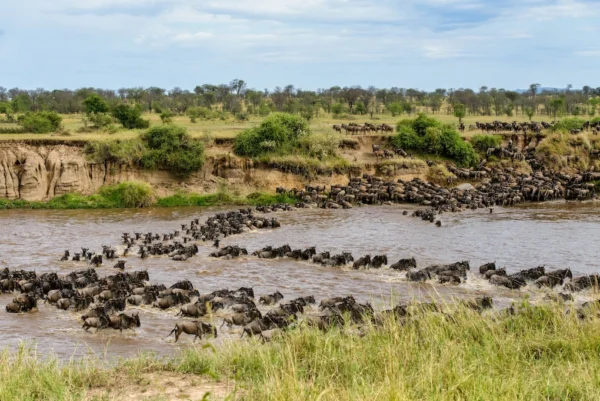
The river crossings are the most dramatic moments of the Wildebeest Migration. While the Mara River is more popular for this sought-after scene of the migration, the Grumeti River crossings, which occur between May and June, are also intense and action-packed.
If you’ve been wondering how to visit Serengeti without crowds, going to the Western Corridor for this experience is one of the best ways to do it.
Although the scale is much smaller than the Mara’s, seeing the creatures struggle to survive the large Nile crocodiles and steep banks is just as thrilling, and it’s a less-crowded alternative to the Mara.
The Mara River, since it’s wider, deeper, flowing faster, and with steeper banks than the Grumeti, is more dangerous and dramatic. When the herds gather at the edge of the Mara River, the atmosphere changes. Some step forward and retreat. Minutes pass. Sometimes hours. Then suddenly, a brave one jumps, and the rest follow.
Thousands of hooves hit the water. The current is strong, and crocodiles wait beneath the surface. The high intensity and the longer Mara River crossings attract much more lions, cheetahs, and hyenas than during the Grumeti River crossings.
But what makes it unforgettable is not just the danger. It is the hesitation before it happens. The tension. The sound of nervous grunts.
And here is the truth many guides will tell you: you might wait and see nothing, or arrive at the perfect moment. The unpredictable nature of the spectacle is part of what makes it special.
Also Read: The Ultimate African Safari Guide: Destinations and Tips for 2026
Every Season of the Great Migration Tells a Different Story
The river crossings are iconic, but it’s just one chapter of the circular movement.
Between January and March, in the Southern Serengeti, over half a million calves are born within weeks. This is where it all begins. The landscape is green and wide open. Newborns take their first steps minutes after birth. Predators take advantage of the abundance and stay close. The predator-prey drama in this season is one of the best safari experiences in Tanzania.
The herds move northwards between April and June. At this time, the movement is more orderly and purposeful. The animals’ first obstacle comes in June, when they cross the Grumeti River.
The Mara River crossings follow, and then there is the return south, then the cycle resets.
Since it’s a year-round spectacle with a series of events, it’s not defined by a single ‘best’ moment. Each stage offers something worth experiencing. Once you understand this before you go to either the Maasai Mara or the Serengeti, you are far less likely to feel disappointed.
It Changes How You See Wildlife
It’s difficult to explain what it feels like standing in the middle of the spectacle. The ground trembles when the herds match across the savanna. The thunderous sound of hooves, which is accompanied by moans, grunts, and snorts, can be heard from miles away. It’s less about wildlife watching and more of a front-row view of an untamed natural phenomenon.
Many people come to finally check the world-famous experience off their bucket list, but they leave feeling smaller in the best possible way.
You realise that the Great Migration is an ancient wonder that began way long before modern borders existed. Long before cameras and safari vehicles. It leaves you with an entirely new perspective.
Also Read: Kenya Vs Tanzania: Which is Better for Safari?
So, is the Great Migration Overrated?
Well, that depends on what you expect.
If you are only visiting for the dramatic river crossings and expect them at a specific hour, you may be disappointed. But if your goal is to witness one of the last great natural movements on Earth, unfold at its own pace, you are unlikely to call it an overrated experience.
The Wildebeest Migration rewards patience and curiosity. It’s ideally suited for travellers who are willing to watch and wait. And in return, it offers something that cannot be recreated anywhere else.
How to Make the Most of Your Experience
- Timing matters, but flexibility is more crucial if you want to enjoy an unforgettable wildlife moment. The animals follow rain, not calendars. When the conditions shift, so does the movement, which is normal.
- Choosing knowledgeable safari guides can make a big difference. They have a perfect understanding of the patterns and positioning, and therefore know when to wait and when to be on the move.
- Stay a little longer. This will increase your chances of witnessing the dramatic moments.
- Most importantly, go with the right mindset. Remember, you are travelling to experience a living ecosystem, not a scripted event.
The Great Migration can be crowded in peak months, but it can be quiet at times. And yes, it’ll definitely test your patience, as we’ve discussed.
But overrated? No.
When millions of animals move together across open land, driven only by instinct and survival, you are witnessing something extraordinary. Few places on Earth can match the splendour, scale, and drama of the Wildebeest Migration. And once you visit either the Serengeti or the Maasai Mara, and experience it, you’ll understand why so many people travel across continents to see it.
Not because it is hyped.